Cases
🤖 How to Automate Marketplace Operations and Increase Product Listing CTR to 2.7%
iFutureArt — a manufacturer of paint-by-numbers kits and a supplier for DIY niche sellers. The team is actively growing sales on Wildberries, Ozon, and other marketplaces. Key objectives — increasing CTR of product listings, promotion, and review management.
Context: Overcrowded Creative Goods Niche
iFutureArt works in the creative goods category — selling paint-by-numbers kits on marketplaces and helping other sellers enter the niche. This is a visually-oriented segment with high competition: purchasing decisions are emotionally driven, and even small content mistakes can reduce visibility and sales.
The team aimed not just to create listings but to manage them systematically: test visuals, track the impact of descriptions, and quickly adapt to changes in platform conditions. But all processes were manual — slowing down progress.
How Things Worked Before AI Automation
Before automation, the team did everything manually: tested images, rewrote descriptions, handled reviews. It took too much time:
- A/B test for one photo took several days of observation
- Writing descriptions took up to 3 hours
- Responding to reviews took up to 4 hours daily
The market, however, doesn’t wait. Marketplace algorithms change, commissions and shipping conditions are revised. Sellers need to make decisions quickly and based on data — or they risk losing their competitive edge.
How the Approach Changed with GenAI Implementation
To speed up operations and reduce manual workload, the iFutureArt team implemented the SellerDen AI service, which includes a set of AI tools for sellers. The goal was not just to automate individual tasks but to build a sustainable process for managing listings: from visuals and descriptions to reviews and exploring new niches. All tools work within a unified system, complementing each other.
What Was Automated:
A/B Testing of Product Covers
The first step was automating A/B testing of images — a key component of the listing.
Previously, these tests were done manually: the team uploaded variants, tracked statistics, and drew conclusions from CTR data.
Now:
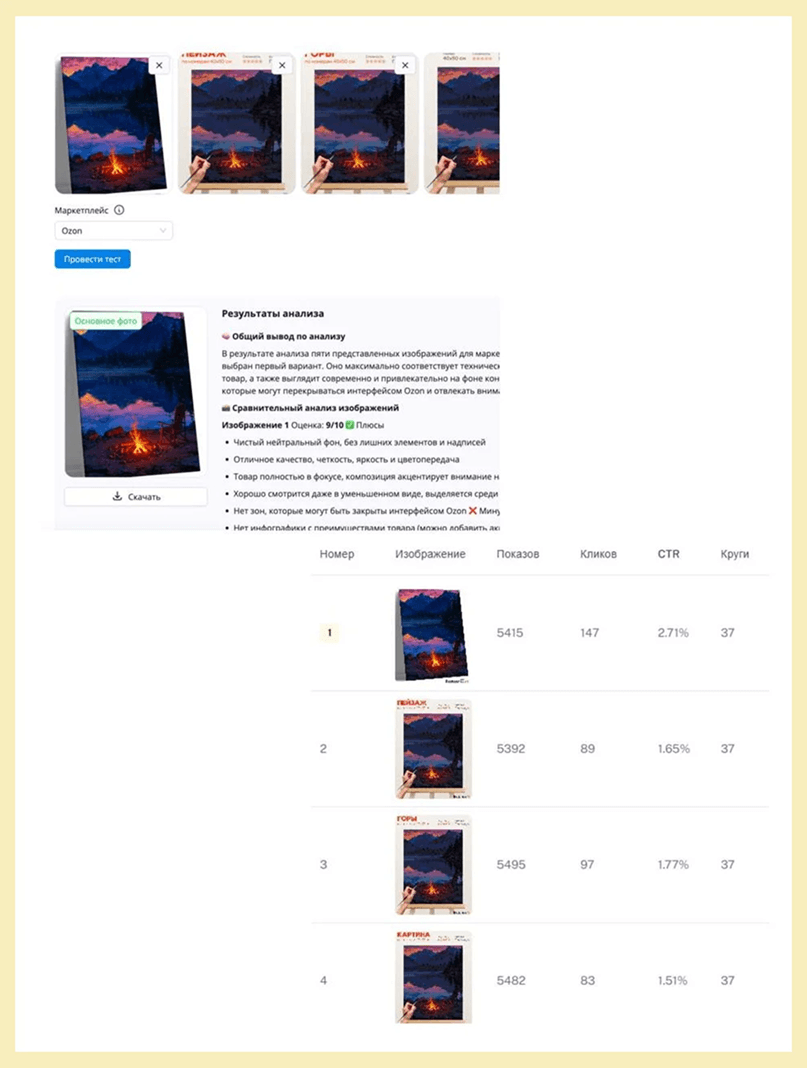
- Up to 5 photo variants are uploaded.
- The system analyzes composition, focus, lighting, and contrast.
- It considers marketplace technical requirements (background, object placement, visual noise).
- Predicts CTR based on historical data.
The model is trained on listings with high conversion and suggests the most clickable option.
A/B testing using the trained model allowed the team to select the best image: CTR increased to 2.7%.
SEO Description Generation
Next, they automated description creation. Previously, text was written manually: keyword selection, structure, adaptation to the platform. Now the process looks like this:
- A short brief (name, characteristics, category) is provided to the system.
- The model generates text considering keywords and marketplace requirements.
- It checks length, readability, uniqueness, and style.
- The description is adapted to the brand’s tone and product category.
As a result, the time for setting up one listing was reduced from several hours to a few minutes, and the quality of texts became consistent and in line with platform standards.
Automatic Review Responses
This category requires constant interaction with buyers. Before automation, managers spent up to 4 hours a day responding to reviews. After implementing auto-responses:
- The system determines the sentiment of the review (positive, neutral, negative).
- Extracts the essence of the feedback (delivery, packaging, quality).
- Generates a response in an appropriate tone.
- Offers the manager a draft that can be sent immediately or edited.
The model is trained on thousands of dialogues and considers emotional tone, avoiding robotic responses. This not only saved time but also improved the quality of customer interactions.
Generating responses with LLM cut down 4 hours of manual work for the manager.
Background and Video Generation from Photos
Previously, basic visuals were edited manually or passed to designers. Now, backgrounds are processed automatically:
- The system isolates the product (semantic segmentation).
- Selects a studio background considering shape, color, and lighting.
- Checks compliance with platform technical requirements.
The model relies on visual patterns from high-CTR listings, helping avoid common mistakes (excess objects, noise, incorrect centering). The "Photo-to-Video Generator" tool allows for creating rich content, bringing paint-by-numbers kits to life.
The background generation feature allowed iFutureArt to eliminate design services and save up to 500 rubles per image.
New Niche Analysis
The team also uses a tool to analyze potential product directions. It examines demand dynamics, offer saturation, seasonality, and the share of newcomers in the category. Based on this data, a list of promising niches is generated. This speeds up the launch of new products and reduces the risk of entering an oversaturated category.
Results: Accelerating Listing Launches and Increasing CTR
After automation, iFutureArt reduced routine tasks by 4 hours a day, sped up listing launches by 5–6 times, and increased CTR to 2.7% right from the first A/B test. Instead of manual work, the team now follows a stable process, with most decisions made based on data. This not only saved time and budget but also provided flexibility in a rapidly changing market.